
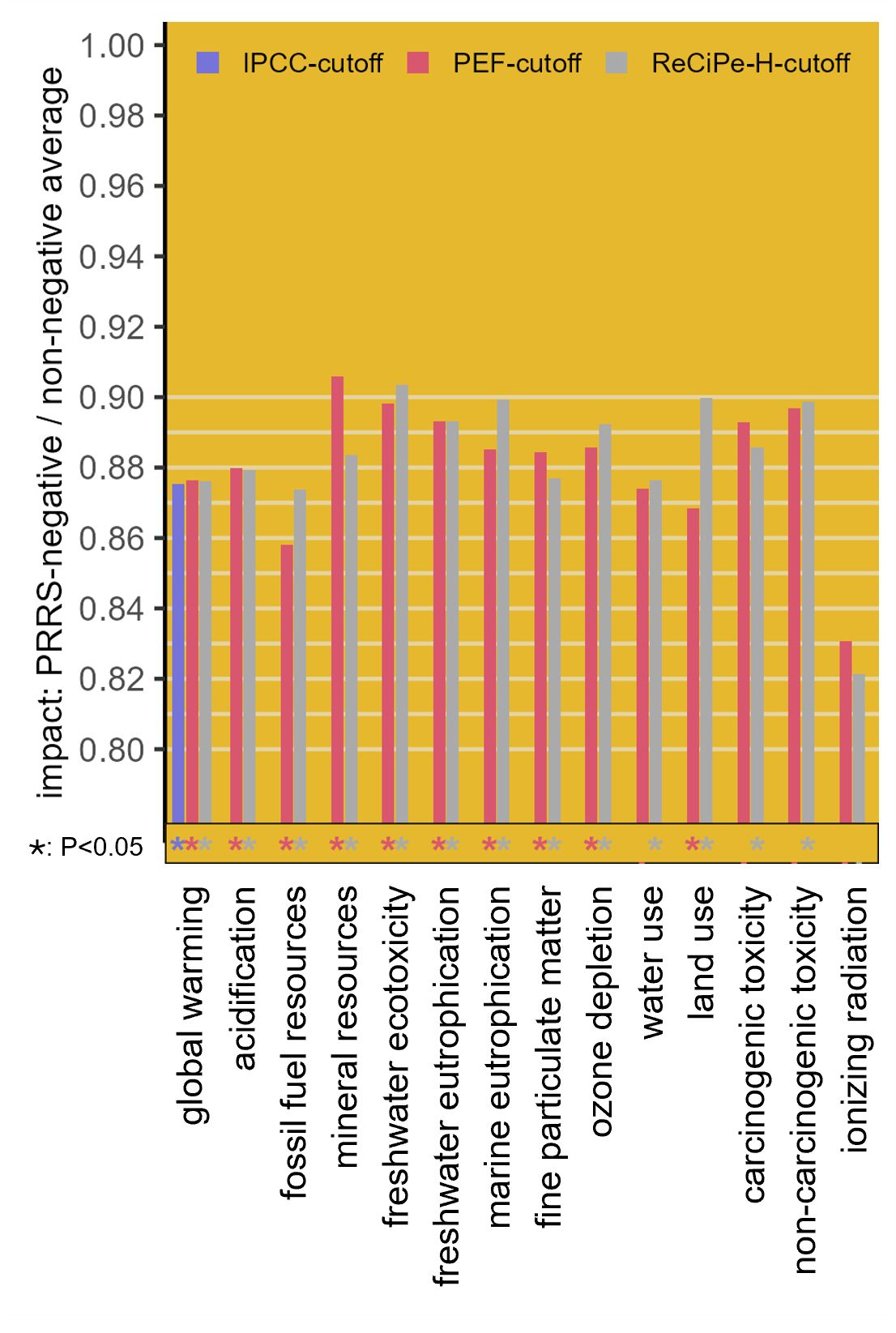
A lifecycle assessment (LCA), published in Frontiers in Veterinary Science, found that eliminating PRRS could reduce greenhouse gas emissions by up-to 9%.
The Porcine Reproductive and Respiratory Syndrome (PRRS) is a viral pig disease that increases mortality rates and reduces (re)production performance. This worsens a farm’s whole-enterprise feed conversion ratio, which increases its greenhouse gas emission. PRRSV elimination should then result in mitigation of global warming. This study quantifies such mitigation of global warming and of other environmental impact categories such as eutrophication and land use by Life Cycle Assessment. The software package openLCA converted material and energy flows to impact categories of frameworks ReCiPe-2016, PEF-3.1, and IPCC-2021. Flows came from data recorded on 173 PRRS outbreaks in 113 sow farms (1.3 million sows), and on 5,650 all-in-all-out groups of wean-to-finish pigs in 63 farms (26 million pigs). We find that the environmental impact of PRRSV-negative North American farms is 4–6% lower than of the North American industry average (a mix of PRRSV-negative and PRRSV-positive farms), and 9–17% lower than of PRRSV-positive farms.